|
数据搜索系统,热门电子元器件搜索 |
|
|
数据搜索系统,热门电子元器件搜索 |
|
STV-366-R01 数据表(PDF) 19 Page - STMicroelectronics |
|
|
|||||||||||||||||||||||||||||
STV-366-R01 数据表(HTML) 19 Page - STMicroelectronics |
|
|
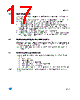
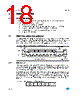
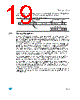
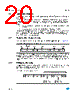
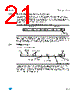
19 / 30 page  VT5366 Serial control bus 19/30 The byte following the address byte contains the address of the first data byte (also referred to as the index). The serial interface can address up to 256 byte registers. Figure 9. Serial interface data format (write ex) 6.2.2 Message interpretation All serial interface communications with the sensor must begin with a start condition. If the start condition is followed by a valid address byte then further communications can take place. The sensor will acknowledge the receipt of a valid address by driving the sda wire low. The state of the read/~write bit (LSB of the address byte) is stored and the next byte of data, sampled from sda, can be interpreted. During a write sequence the second byte sent is an address index and is used to point to one of the internal registers. The receiver will automatically increment the index address by one location after each slave acknowledge. The master can therefore send data bytes continuously to the slave until the slave fails to provide an acknowledge or the master terminates the write communication with a stop condition or sends a repeated start, (Sr). As data is received by the slave it is written bit by bit to a serial/parallel register. After each data byte has been received by the slave, an acknowledge is generated, the data is then stored in the internal register addressed by the current index. During a read message, the next byte read from the slave device are the contents of the register addressed by the current index. The contents of this register are then parallel loaded into the serial/parallel register and clocked out of the device by scl. At the end of each byte, in both read and write message sequences, an acknowledge is issued by the receiving device. A positive acknowledge involves holding the SDA line LOW, a negative acknowledge involves releasing the SDA line to be pulled HIGH. Although the VT5366 is always considered to be a slave device, it acts as a transmitter when the bus master requests a read from the sensor. A message can only be terminated by the bus master, either by issuing a stop condition, a repeated start condition or by a negative acknowledge after reading a complete byte during a read operation. S address[7:1] R/W bit A DATA[7:0] A Sensor acknowledges valid address Acknowledge from slave INDEX[7:0] P A A DATA[7:0] R/W |
|
|
链接网址 |
| ALLDATASHEET是否为您带来帮助? [ DONATE ] |
关于 Alldatasheet | 广告服务 | 联系我们 | 隐私政策 | 数据表链接 | 链接交换 | 制造商名单 All Rights Reserved©Alldatasheet.com |
| Russian : Alldatasheetru.com | Korean : Alldatasheet.co.kr | Spanish : Alldatasheet.es | French : Alldatasheet.fr | Italian : Alldatasheetit.com Portuguese : Alldatasheetpt.com | Polish : Alldatasheet.pl | Vietnamese : Alldatasheet.vn Indian : Alldatasheet.in | Mexican : Alldatasheet.com.mx | British : Alldatasheet.co.uk | New Zealand : Alldatasheet.co.nz |
|
Family Site : ic2ic.com |
icmetro.com |
 Chinese ▼
 English
 Chinese
 German
 Japanese
 Russian
 Korean
 Spanish
 French
 Italian
 Portuguese
 Polish
 Vietnamese
 Indian
 Mexican
 British
 New Zealand