|
数据搜索系统,热门电子元器件搜索 |
|
|
数据搜索系统,热门电子元器件搜索 |
|
PAM8303DASC 数据表(PDF) 12 Page - Power Analog Micoelectronics |
|
|
|||||||||||||||||||||||||||||
PAM8303DASC 数据表(HTML) 12 Page - Power Analog Micoelectronics |
|
|
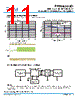
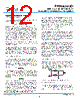
12 / 17 page  Input Resistance (Ri) Input Capacitors (Ci ) Decoupling Capacitor (C ) How to Reduce EMI The input resistors (Ri) set the gain of the amplifier according to Equation 1. Resistor matching is very important in fully differential amplifiers. The balance of the output on the reference voltage depends on matched ratios of the resistors. CMRR, PSRR, and cancellation of the second harmonic distortion diminish if resistor mismatch occurs. Therefore, it is recommended to use 1% tolerance resistors or better to keep the performance optimized. Matching is more important than overall tolerance. Resistor arrays with 1% matching can be used with a tolerance greater than 1%. Place the input resistors very close to the PAM8303D to limit noise injection on the high- impedance nodes. For optimal performance the gain should be set to 2X(Ri=150k) or lower. Lower gain allows the PAM8303D to operate at its best, and keeps a high voltage at the input making the inputs less susceptible to noise. In addition to these features, higher value of Ri minimizes pop noise. In the typical application, an input capacitor, Ci, is required to allow the amplifier to bias the input signal to the proper DC level for optimum operation. In this case, Ci and the minimum input impedance Ri form is a high-pass filter with the corner frequency determined in the follow equation: It is important to consider the value of Ci as it directly affects the low frequency performance of the circuit. For example, when Ri is 150k and the specification calls for a flat bass response are down to 150Hz. Equation is reconfigured as followed: When input resistance variation is considered, the Ci is 7nF, so one would likely choose a value of 10nF. A further consideration for this capacitor is the leakage path from the input source through the input network ( , ) to the load. This leakage current creates a DC offset voltage at the input to the amplifier that reduces useful headroom, especially in high gain applications. For this reason, a low-leakage tantalum or ceramic capacitor is the best choice. When polarized capacitors are used, the positive side of the capacitor should face the amplifier input in most applications as the DC level is held at V /2, which is likely higher than the source DC level. Please note that it is important to confirm the capacitor polarity in the application. The PAM8303D is a high-performance CMOS audio amplifier that requires adequate power supply decoupling to ensure the output total harmonic distortion (THD) as low as possible. Power supply decoupling also prevents the oscillations causing by long lead length between the amplifier and the speaker. The optimum decoupling is achieved by using two different types of capacitors that target on different types of noise on the power supply leads. For higher frequency transients, spikes, or digital hash on the line, a good low equivalent- series-resistance (ESR) ceramic capacitor, typically 1 F, is placed as close as possible to the device each VDD and PVDD pin for the best operation. For filtering lower frequency noise signals, a large ceramic capacitor of 10 F or greater placed near the audio power amplifier is recommended. Most applications require a ferrite bead filter for EMI elimination shown at Figure 1. The ferrite filter reduces EMI around 1MHz and higher. When selecting a ferrite bead, choose one with high impedance at high frequencies, but low impedance at low frequencies. Figure 1: Ferrite Bead Filter to Reduce EMI Ω μ DD S Ci Ri + Rf In order to reduce power consumption while not in use, the PAM8303D contains shutdown circuitry that is used to turn off the amplifier’s bias circuitry. This shutdown feature turns the μ Shutdown operation Application Information PAM8303D Ultra Low EMI, 3W Filterless Mono Class-D Audio Power Amplifier 12 , Power Analog Microelectronics Inc www.poweranalog.com 2 150k V Gain Ri V ´W æö = ç÷ èø () C 1 f 2RiCi p = () ic 1 Ci 2R f p = 200pF 200pF OUT+ OUT- Ferrite Bead Ferrite Bead 09/2008 Rev 1.4 |
|
|
链接网址 |
| ALLDATASHEET是否为您带来帮助? [ DONATE ] |
关于 Alldatasheet | 广告服务 | 联系我们 | 隐私政策 | 数据表链接 | 链接交换 | 制造商名单 All Rights Reserved©Alldatasheet.com |
| Russian : Alldatasheetru.com | Korean : Alldatasheet.co.kr | Spanish : Alldatasheet.es | French : Alldatasheet.fr | Italian : Alldatasheetit.com Portuguese : Alldatasheetpt.com | Polish : Alldatasheet.pl | Vietnamese : Alldatasheet.vn Indian : Alldatasheet.in | Mexican : Alldatasheet.com.mx | British : Alldatasheet.co.uk | New Zealand : Alldatasheet.co.nz |
|
Family Site : ic2ic.com |
icmetro.com |
 Chinese ▼
 English
 Chinese
 German
 Japanese
 Russian
 Korean
 Spanish
 French
 Italian
 Portuguese
 Polish
 Vietnamese
 Indian
 Mexican
 British
 New Zealand