|
数据搜索系统,热门电子元器件搜索 |
|
|
数据搜索系统,热门电子元器件搜索 |
|
AD8223ARM-R7 数据表(PDF) 19 Page - Analog Devices |
|
|
|||||||||||||||||||||||||||||
AD8223ARM-R7 数据表(HTML) 19 Page - Analog Devices |
|
|
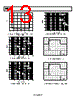
19 / 21 page  AD8223 Rev. 0 | Page 18 of 20 Driving a Cable All cables have a certain capacitance per unit length, which varies widely with cable type. The capacitive load from the cable may cause peaking in the output response of the AD8223. To reduce the peaking, use a resistor between the AD8223 and the cable. Because cable capacitance and desired output response vary widely, this resistor is best determined empirically. A good starting point is 75 Ω. The AD8232 operates at a low enough frequency that transmission line effects are rarely an issue; therefore, the resistor need not match the characteristic impedance of the cable. AD8223 (DIFF OUT) AD8223 (SINGLE OUT) Figure 40. Driving a Cable A SINGLE-SUPPLY DATA ACQUISITION SYSTEM Interfacing bipolar signals to single-supply analog-to-digital converters (ADCs) presents a challenge. The bipolar signal must be mapped into the input range of the ADC. Figure 41 shows how this translation can be achieved. ±10mV 5V AD8223 REF 5V AD7776 5V + – AIN REFOUT REFIN 0.1µF 0.1µF RG 1.02kΩ Figure 41. A Single-Supply Data Acquisition System The bridge circuit is excited by a +5 V supply. The full-scale output voltage from the bridge (±10 mV), therefore, has a common- mode level of 2.5 V. The AD8223 removes the common-mode component and amplifies the input signal by a factor of 100 (RG = 1.02 kΩ). This results in an output signal of ±1 V. To prevent this signal from running into the AD8223 ground rail, the voltage on the REF pin must be raised to at least 1 V. In this example, the 2 V reference voltage from the AD7776 ADC is used to bias the AD8223 output voltage to 2 V ± 1 V, which corresponds to the input range of the ADC. AMPLIFYING SIGNALS WITH LOW COMMON- MODE VOLTAGE Because the common-mode input range of the AD8223 extends 0.15 V below ground, it is possible to measure small differential signals that have low, or no, common-mode components. Figure 42 shows a thermocouple application in which one side of the J-type thermocouple is grounded. 2V 5V AD8223 REF 0.1µF VOUT RG 1.02kΩ + – J-TYPE THERMOCOUPLE Figure 42. Amplifying Bipolar Signals with Low Common-Mode Voltage Over a temperature range of −200°C to +200°C, the J-type thermocouple delivers a voltage ranging from −7.890 mV to +10.777 mV. A programmed gain on the AD8223 of 100 (RG = 845) and a voltage on the AD8223 REF pin of 2 V results in the AD8223 output voltage ranging from 1.110 V to 3.077 V relative to ground. |
|
|
链接网址 |
| ALLDATASHEET是否为您带来帮助? [ DONATE ] |
关于 Alldatasheet | 广告服务 | 联系我们 | 隐私政策 | 数据表链接 | 链接交换 | 制造商名单 All Rights Reserved©Alldatasheet.com |
| Russian : Alldatasheetru.com | Korean : Alldatasheet.co.kr | Spanish : Alldatasheet.es | French : Alldatasheet.fr | Italian : Alldatasheetit.com Portuguese : Alldatasheetpt.com | Polish : Alldatasheet.pl | Vietnamese : Alldatasheet.vn Indian : Alldatasheet.in | Mexican : Alldatasheet.com.mx | British : Alldatasheet.co.uk | New Zealand : Alldatasheet.co.nz |
|
Family Site : ic2ic.com |
icmetro.com |
 Chinese ▼
 English
 Chinese
 German
 Japanese
 Russian
 Korean
 Spanish
 French
 Italian
 Portuguese
 Polish
 Vietnamese
 Indian
 Mexican
 British
 New Zealand