|
数据搜索系统,热门电子元器件搜索 |
|
|
数据搜索系统,热门电子元器件搜索 |
|
AD8616ARMZ-R21 数据表(PDF) 14 Page - Analog Devices |
|
|
|||||||||||||||||||||||||||||
AD8616ARMZ-R21 数据表(HTML) 14 Page - Analog Devices |
|
|
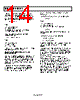
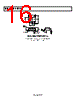
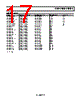
14 / 20 page  AD8615/AD8616/AD8618 Rev. C | Page 14 of 20 These thermal resistance curves were determined using the AD8616 thermal resistance data for each package and a maximum junction temperature of 150°C. The following formula can be used to calculate the internal junction tem- perature of the AD8615/AD8616/AD8618 for any application: TJ = PDISS × θJA + TA where: TJ = junction temperature PDISS = power dissipation θJA = package thermal resistance, junction-to-case TA = ambient temperature of the circuit To calculate the power dissipated by the AD8615/ AD8616/AD8618, use PDISS = ILOAD × (VS – VOUT) where: ILOAD = output load current VS = supply voltage VOUT = output voltage The quantity within the parentheses is the maximum voltage developed across either output transistor. POWER CALCULATIONS FOR VARYING OR UNKNOWN LOADS Often, calculating power dissipated by an integrated circuit to determine if the device is being operated in a safe range is not as simple as it might seem. In many cases, power cannot be directly measured. This may be the result of irregular output waveforms or varying loads. Indirect methods of measuring power are required. There are two methods to calculate power dissipated by an integrated circuit. The first is to measure the package temperature and the board temperature. The second is to directly measure the circuits supply current. Calculating Power by Measuring Ambient and Case Temperature The two equations for calculating junction temperature are TJ = TA + P θJA where: TJ = junction temperature TA = ambient temperature θJA = the junction-to-ambient thermal resistance TJ = TC + P θJC where TC is case temperature and θJA and θJC are given in the data sheet. The two equations for calculating P (power) are TA + P θJA = TC + P θJC P = (TA – TC)/(θJC – θJA) Once power has been determined, it is necessary to recalculate the junction temperature to ensure that it has not been exceeded. The temperature should be measured directly on and near the package, but not touching it. Measuring the package can be difficult. A very small bimetallic junction glued to the package can be used, or an infrared sensing device can be used if the spot size is small enough. Calculating Power by Measuring Supply Current Power can be calculated directly if the supply voltage and current are known. However, the supply current can have a dc component with a pulse directed into a capacitive load, which could make the rms current very difficult to calculate. This difficulty can be overcome by lifting the supply pin and inserting an rms current meter into the circuit. For this method to work, make sure the current is delivered by the supply pin being measured. This is usually a good method in a single- supply system; however, if the system uses dual supplies, both supplies may need to be monitored. |
|
|
链接网址 |
| ALLDATASHEET是否为您带来帮助? [ DONATE ] |
关于 Alldatasheet | 广告服务 | 联系我们 | 隐私政策 | 数据表链接 | 链接交换 | 制造商名单 All Rights Reserved©Alldatasheet.com |
| Russian : Alldatasheetru.com | Korean : Alldatasheet.co.kr | Spanish : Alldatasheet.es | French : Alldatasheet.fr | Italian : Alldatasheetit.com Portuguese : Alldatasheetpt.com | Polish : Alldatasheet.pl | Vietnamese : Alldatasheet.vn Indian : Alldatasheet.in | Mexican : Alldatasheet.com.mx | British : Alldatasheet.co.uk | New Zealand : Alldatasheet.co.nz |
|
Family Site : ic2ic.com |
icmetro.com |
 Chinese ▼
 English
 Chinese
 German
 Japanese
 Russian
 Korean
 Spanish
 French
 Italian
 Portuguese
 Polish
 Vietnamese
 Indian
 Mexican
 British
 New Zealand