|
数据搜索系统,热门电子元器件搜索 |
|
|
数据搜索系统,热门电子元器件搜索 |
|
SSM2335CBZ-R2 数据表(PDF) 12 Page - Analog Devices |
|
|
|||||||||||||||||||||||||||||
SSM2335CBZ-R2 数据表(HTML) 12 Page - Analog Devices |
|
|
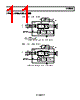
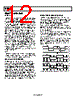
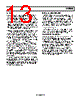
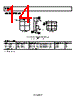
12 / 16 page  SSM2335 Rev. 0 | Page 12 of 1 6 OUTPUT > 0V +5V 0V THEORY OF OPERATION OVERVIEW The SSM2335 mono Class-D audio amplifier features a filterless modulation scheme that greatly reduces the external component count, conserving board space and, thus, reducing systems cost. The SSM2335 does not require an output filter but, instead, relies on the inherent inductance of the speaker coil and the natural filtering of the speaker and human ear to fully recover the audio component of the square wave output. Most Class-D amplifiers use some variation of pulse-width modulation (PWM), but the SSM2335 uses Σ-Δ modulation to determine the switching pattern of the output devices, resulting in a number of important benefits. Σ-Δ modulators do not produce a sharp peak with many harmonics in the AM frequency band, as pulse-width modulators often do. Σ-Δ modulation provides the benefits of reducing the amplitude of spectral components at high frequencies, that is, reducing EMI emission that might otherwise be radiated by speakers and long cable traces. The SSM2335 does not require external EMI filtering for twisted speaker cable lengths shorter than 10 cm. Due to the inherent spread-spectrum nature of Σ-Δ modulation, the need for oscillator synchronization is eliminated for designs incorporating multiple SSM2335 amplifiers. The SSM2335 also offers protection circuits for overcurrent and temperature protection. GAIN The SSM2335 has a default gain of 18 dB that can be reduced by using a pair of external resistors with a value calculated as follows: External Gain Settings = 160 kΩ/(20 kΩ + REXT) POP-AND-CLICK SUPPRESSION Voltage transients at the output of audio amplifiers can occur when shutdown is activated or deactivated. Voltage transients as low as 10 mV can be heard as an audio pop in the speaker. Clicks and pops can also be classified as undesirable audible transients generated by the amplifier system and, therefore, as not coming from the system input signal. Such transients may be generated when the amplifier system changes its operating mode. For example, the following may be sources of audible transients: system power-up and power-down, mute and unmute, input source change, and sample rate change. The SSM2335 has a pop-and-click suppression architecture that reduces these out- put transients, resulting in noiseless activation and deactivation. OUTPUT MODULATION DESCRIPTION The SSM2335 uses three-level, Σ-Δ output modulation. Each output can swing from GND to VDD and vice versa. Ideally, when no input signal is present, the output differential voltage is 0 V because there is no need to generate a pulse. In a real-world situation, there are always noise sources present. Due to this constant presence of noise, a differential pulse is generated, when required, in response to this stimulus. A small amount of current flows into the inductive load when the differ- ential pulse is generated. Most of the time, however, output differential voltage is 0 V, due to the Analog Devices patent pending, three-level, Σ-Δ output modulation. This feature ensures that the current flowing through the inductive load is small. When the user wants to send an input signal, an output pulse is generated to follow the input voltage. The differential pulse density is increased by raising the input signal level. Figure 33 depicts three-level, Σ-Δ output modulation with and without input stimulus. OUT+ +5V 0V OUT– +5V 0V VOUT OUTPUT < 0V +5V 0V OUT+ +5V 0V OUT– 0V –5V VOUT OUTPUT = 0V OUT+ +5V 0V +5V 0V OUT– +5V –5V 0V VOUT Figure 33. Three-Level, Σ-Δ Output Modulation With and Without Input Stimulus |
|
|
链接网址 |
| ALLDATASHEET是否为您带来帮助? [ DONATE ] |
关于 Alldatasheet | 广告服务 | 联系我们 | 隐私政策 | 数据表链接 | 链接交换 | 制造商名单 All Rights Reserved©Alldatasheet.com |
| Russian : Alldatasheetru.com | Korean : Alldatasheet.co.kr | Spanish : Alldatasheet.es | French : Alldatasheet.fr | Italian : Alldatasheetit.com Portuguese : Alldatasheetpt.com | Polish : Alldatasheet.pl | Vietnamese : Alldatasheet.vn Indian : Alldatasheet.in | Mexican : Alldatasheet.com.mx | British : Alldatasheet.co.uk | New Zealand : Alldatasheet.co.nz |
|
Family Site : ic2ic.com |
icmetro.com |
 Chinese ▼
 English
 Chinese
 German
 Japanese
 Russian
 Korean
 Spanish
 French
 Italian
 Portuguese
 Polish
 Vietnamese
 Indian
 Mexican
 British
 New Zealand