|
数据搜索系统,热门电子元器件搜索 |
|
|
数据搜索系统,热门电子元器件搜索 |
|
AD8494ARMZ-R7 数据表(PDF) 12 Page - Analog Devices |
|
|
|||||||||||||||||||||||||||||
AD8494ARMZ-R7 数据表(HTML) 12 Page - Analog Devices |
|
|
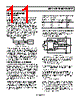
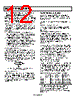
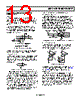
12 / 16 page  AD8494/AD8495/AD8496/AD8497 Rev. 0 | Page 12 of 16 The small thermocouple voltages mean that signals are quite vulnerable to interference, especially when measured with single-ended amplifiers. The AD849x addresses this issue in several ways. Low input bias currents and high input impedance allow for easy filtering at the inputs. The excellent common-mode rejection of the AD849x prevents variations in ground potential and other common-mode noise from affecting the measurement. Temperature Sensor (Cold Junction Compensation) The AD849x also includes a temperature sensor for cold junc- tion compensation. This temperature sensor is used to measure the reference junction temperature of the thermocouple and to cancel its effect. • The AD8494/AD8495 cold junction compensation is optimized for operation in a lab environment, where the ambient temperature is around 25°C. The AD8494/AD8495 are specified for an ambient range of 0°C to 50°C. • The AD8496/AD8497 cold junction compensation is optimized for operation in a less controlled environment, where the temperature is around 60°C. The AD8496/AD8497 are specified for an ambient range of 25°C to 100°C. Application examples for the AD8496/AD8497 include automotive applications, autoclave, and ovens. Thermocouple Break Detection The AD849x offers open thermocouple detection. The inputs of the AD849x are PNP type transistors, which means that the bias current always flows out of the inputs. Therefore, the input bias current drives any unconnected input high, which rails the output. Connecting the negative input to ground through a 1 MΩ resistor causes the AD849x output to rail high in an open thermocouple condition (see Figure 6, Figure 28, and the Ground Connection section). 1M Ω Figure 28. Ground the Negative Input Through a 1 MΩ Resistor for Open Thermocouple Detection Input Voltage Protection The AD849x has very robust inputs. Input voltages can be up to 25 V from the opposite supply rail. For example, with a +5 V positive supply and a −3 V negative supply, the part can safely withstand voltages at the inputs from −20 V to +22 V. Voltages at the reference and sense pins should not go beyond 0.3 V of the supply rails. MAXIMUM ERROR CALCULATION As is normally the case, the AD849x outputs are subject to calibration, gain, and temperature sensitivity errors. The user can calculate the maximum error from the AD849x using the following information. The five primary sources of AD849x error are described in this section. AD849x Initial Calibration Accuracy Error at the initial calibration point can be easily calibrated out with a one-point temperature calibration. See Table 2 for the specifications. AD849x Ambient Temperature Rejection The specified ambient temperature rejection represents the ability of the AD849x to reject errors caused by changes in the ambient temperature/reference junction. For example, with 0.025°C/°C ambient temperature rejection, a 20°C change in the reference junction temperature adds less than 0.5°C error to the measurement. See Table 2 for the specifications. AD849x Gain Error Gain error is the amount of additional error when measuring away from the measurement junction calibration point. For example, if the part is calibrated at 25°C and the measurement junction is 100°C with a gain error of 0.1%, the gain error contribution is (100°C − 25°C) × (0.1%) = 0.075°C. This error can be calibrated out with a two-point calibration if needed, but it is usually small enough to ignore. See Table 2 for the specifications. Manufacturing Tolerances of the Thermocouple Consult the data sheet for your thermocouple to find the specified tolerance of the thermocouple. Linearity Error of the Thermocouple Each part in the AD849x family is precision trimmed to optimize a linear operating range for a specific thermocouple type and for the widest possible measurement and ambient temperature ranges. The AD849x achieves a linearity error of less than ±2°C, within the specified operating ranges listed in Table 7. This error is due only to the nonlinearity of the thermocouple. Table 7. AD849x ±2°C Accuracy Temperature Ranges Part Thermo- couple Type Max Error Ambient Temperature Range Measurement Temperature Range AD8494 J ±2°C 0°C to 50°C −35°C to +95°C AD8495 K ±2°C 0°C to 50°C −25°C to +400°C AD8496 J ±2°C 25°C to 100°C +55°C to +565°C AD8497 K ±2°C 25°C to 100°C −25°C to +295°C For temperature ranges outside those listed in Table 7 or for instructions on how to correct for thermocouple nonlinearity error with software, see the product page for the AD8494, AD8495, AD8496, or AD8497, or contact an Analog Devices representative. |
|
|
链接网址 |
| ALLDATASHEET是否为您带来帮助? [ DONATE ] |
关于 Alldatasheet | 广告服务 | 联系我们 | 隐私政策 | 数据表链接 | 链接交换 | 制造商名单 All Rights Reserved©Alldatasheet.com |
| Russian : Alldatasheetru.com | Korean : Alldatasheet.co.kr | Spanish : Alldatasheet.es | French : Alldatasheet.fr | Italian : Alldatasheetit.com Portuguese : Alldatasheetpt.com | Polish : Alldatasheet.pl | Vietnamese : Alldatasheet.vn Indian : Alldatasheet.in | Mexican : Alldatasheet.com.mx | British : Alldatasheet.co.uk | New Zealand : Alldatasheet.co.nz |
|
Family Site : ic2ic.com |
icmetro.com |
 Chinese ▼
 English
 Chinese
 German
 Japanese
 Russian
 Korean
 Spanish
 French
 Italian
 Portuguese
 Polish
 Vietnamese
 Indian
 Mexican
 British
 New Zealand