|
数据搜索系统,热门电子元器件搜索 |
|
|
数据搜索系统,热门电子元器件搜索 |
|
PPC405GPR-3JB266Z 数据表(PDF) 44 Page - Applied Micro Circuits Corporation |
|
|
|||||||||||||||||||||||||||||
PPC405GPR-3JB266Z 数据表(HTML) 44 Page - Applied Micro Circuits Corporation |
|
|
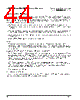
44 / 57 page  405GPr – Power PC 405GPr Embedded Processor 44 AMCC Revision 2.04 – September 7, 2007 Data Sheet Spread Spectrum Clocking Care must be taken when using a spread spectrum clock generator (SSCG) with the PPC405GPr. This controller uses a PLL for clock generation inside the chip. The accuracy with which the PLL follows the SSCG is referred to as tracking skew. The PLL bandwidth and phase angle determine how much tracking skew there is between the SSCG and the PLL for a given frequency deviation and modulation frequency. When using an SSCG with the PPC405GPr the following conditions must be met: • The frequency deviation must not violate the minimum clock cycle time. Therefore, when operating the PPC405GPr with one or more internal clocks at their maximum supported frequency, the SSCG can only lower the frequency. • The maximum frequency deviation cannot exceed −3%, and the modulation frequency cannot exceed 40kHz. In some cases, on-board PPC405GPr peripherals impose more stringent requirements (see Note 1). • Use the peripheral bus clock (PerClk) for logic that is synchronous to the peripheral bus since this clock tracks the modulation. • Use the SDRAM MemClkOut since it also tracks the modulation. Notes: 1. The serial port baud rates are synchronous to the modulated clock. The serial port has a tolerance of approximately 1.5% on baud rate before framing errors begin to occur. The 1.5% tolerance assumes that the connected device is running at precise baud rates. If an external serial clock is used the baud rate is unaffected by the modulation. 2. Operation of the PPC405GPr PCI Bridge is unaffected by the use of a SSCG. For PCI frequencies of 33.33 MHz and below the PCI controller supports synchronous mode operation. This is accomplished by strapping the PPC405GPr for synchronous mode PCI and connecting the PCI bus clock to the PPC405GPr SysClk input. For 33.33 MHz signalling, the PCI specification has no limitation on the amount of frequency deviation or modulation that may be applied to the PCI clock. Therefore, the PPC405GPr SSCG requirements stated above take precedence. At PCI frequencies above 33.33 MHz, the PCI controller must be operated in asynchronous mode. When in asynchronous mode, the PCI bus clock must be driven into the PPC405GPr PCIClk input. In this configuration the PCI controller supports the 66.66 MHz PCI clock specification which specifies a maximum frequency deviation of -1% at a modulation of between 30 kHz and 33 kHz. 3. Ethernet operation is unaffected. 4. IIC operation is unaffected. Caution: It is up to the system designer to ensure that any SSCG used with the PPC405GPr meets the above requirements and does not adversely affect other aspects of the system. |
|
链接网址 |
| ALLDATASHEET是否为您带来帮助? [ DONATE ] |
关于 Alldatasheet | 广告服务 | 联系我们 | 隐私政策 | 数据表链接 | 链接交换 | 制造商名单 All Rights Reserved©Alldatasheet.com |
| Russian : Alldatasheetru.com | Korean : Alldatasheet.co.kr | Spanish : Alldatasheet.es | French : Alldatasheet.fr | Italian : Alldatasheetit.com Portuguese : Alldatasheetpt.com | Polish : Alldatasheet.pl | Vietnamese : Alldatasheet.vn Indian : Alldatasheet.in | Mexican : Alldatasheet.com.mx | British : Alldatasheet.co.uk | New Zealand : Alldatasheet.co.nz |
|
Family Site : ic2ic.com |
icmetro.com |
 Chinese ▼
 English
 Chinese
 German
 Japanese
 Russian
 Korean
 Spanish
 French
 Italian
 Portuguese
 Polish
 Vietnamese
 Indian
 Mexican
 British
 New Zealand