|
数据搜索系统,热门电子元器件搜索 |
|
|
数据搜索系统,热门电子元器件搜索 |
|
KSZ9567R 数据表(PDF) 56 Page - Microchip Technology |
|
|
|||||||||||||||||||||||||||||
KSZ9567R 数据表(HTML) 56 Page - Microchip Technology |
|
|
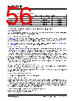
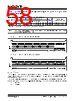
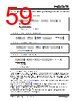
56 / 233 page  KSZ9567R DS00002329E-page 56 2022 Microchip Technology Inc. and its subsidiaries There is one additional power saving mode that may be implemented on a per-port basis: • Port-Based Power Down The first three global power modes are mutually exclusive; only one mode may be selected at a time. Port-based power down may be enabled independent of the global power mode. 4.10.1 NORMAL OPERATION MODE At power-up, the device enters into Normal operation mode. It is also selected via bits [4:3] = 00 in the Power Down Control 0 Register. When the device is in normal operation mode, all PLL clocks are running, PHYs and MACs are on, and the CPU is ready to read or write the device registers through the serial interface (SPI, I2C or MIIM). During normal operation mode, the host processor can change the power management mode bits in the Power Down Control 0 Register to transition to any of the other power management modes. 4.10.2 ENERGY-DETECT MODE Energy-detect mode, also known as energy-detect power down (EDPD) mode, is enabled by setting bits [4:3] to 01 in the Power Down Control 0 Register. Energy-detect mode provides a mechanism to save power when the device is not connected to an active link partner. Auto-negotiation must be enabled when in energy-detect mode. Energy-detect mode consists of two states, normal-power state and low-power state. When the device is in this mode, it will monitor the cable energy. If there is no energy on the cable for a time longer than a pre-configured value, the device will go into the low-power state. While in low-power state, the device reduces power consumption by disabling all cir- cuitry except the energy-detect circuitry of the receiver, which consumes minimal power. When the device is in the low- power state, it will transmit link pulses at long intervals, with a very low duty cycle. At the same time, it continuously monitors for energy on the cable. Once energy is detected from the cable and is present for a time longer than 100ns, the device will enter the normal-power state. 4.10.3 GLOBAL SOFT POWER-DOWN MODE Soft power-down mode is used to power down the device when it is not in use after power-up. This mode disables all internal functions except for the serial (SPI or I2C) management interface. When soft power-down mode is exited, all registers are reset to their default values, and all configuration strap pins are sampled to set the device settings. 4.10.4 PORT-BASED POWER DOWN Unused ports may be powered down individually to save power. 4.10.5 WAKE ON LAN (WOL) Wake on LAN allows a computer to be turned on or woken up by a network message. The message is usually sent by a program executed on another computer on the same local area network. Wake-up frame events are used to awaken the system whenever meaningful data is presented to the system over the network. Examples of meaningful data include the reception of a Magic Packet, a management request from a remote administrator, or simply network traffic directly targeted to the local system. The device can be programmed to notify the host of the Wake-Up frame detection with the assertion of the power management event signal (PME_N). The device’s MACs support the detection of the following Wake-Up events: • Detection of energy signal over a pre-configured value • Detection of a linkup in the network link state TABLE 4-24: MDI/MDI-X PIN DEFINITIONS Functional Blocks Power Management Operation Modes Normal Mode Energy Detect Mode Soft Power Down Mode Internal PLL Clock Enabled Disabled Disabled TX/RX PHYs Enabled Energy Detect at RX Disabled MACs Enabled Disabled Disabled Host Interface Enabled Disabled Disabled |
|
链接网址 |
| ALLDATASHEET是否为您带来帮助? [ DONATE ] |
关于 Alldatasheet | 广告服务 | 联系我们 | 隐私政策 | 数据表链接 | 链接交换 | 制造商名单 All Rights Reserved©Alldatasheet.com |
| Russian : Alldatasheetru.com | Korean : Alldatasheet.co.kr | Spanish : Alldatasheet.es | French : Alldatasheet.fr | Italian : Alldatasheetit.com Portuguese : Alldatasheetpt.com | Polish : Alldatasheet.pl | Vietnamese : Alldatasheet.vn Indian : Alldatasheet.in | Mexican : Alldatasheet.com.mx | British : Alldatasheet.co.uk | New Zealand : Alldatasheet.co.nz |
|
Family Site : ic2ic.com |
icmetro.com |
 Chinese ▼
 English
 Chinese
 German
 Japanese
 Russian
 Korean
 Spanish
 French
 Italian
 Portuguese
 Polish
 Vietnamese
 Indian
 Mexican
 British
 New Zealand