|
数据搜索系统,热门电子元器件搜索 |
|
|
数据搜索系统,热门电子元器件搜索 |
|
FT260Q-R 数据表(PDF) 19 Page - Future Technology Devices International Ltd. |
|
|
|||||||||||||||||||||||||||||
FT260Q-R 数据表(HTML) 19 Page - Future Technology Devices International Ltd. |
|
|
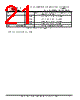
19 / 61 page  Copyright © Future Technology Devices International Limited 19 FT260 HID-CLASS USB TO UART/I2C BRIDGE IC Version 1.1 Document No.: FT_001272 Clearance No.: FTDI#484 The following figure shows the basic I2C bus protocol Figure 5.1 I2C Bus Protocol The master is initially in master transmit mode by sending a start bit followed by the 7-bit address of the slave it wishes to communicate with, which is finally followed by a single bit representing whether it wishes to write(0) to or read(1) from the slave. If the slave exists on the bus then it will respond with an ACK bit (active low for acknowledged) for that address. The master then continues in either transmit or receive mode (according to the read/write bit it sent), and the slave continues in its complementary mode (receive or transmit, respectively). The address and the data bytes are sent most significant bit first. The start bit is indicated by a high-to- low transition of SDA with SCL high; the stop bit is indicated by a low-to-high transition of SDA with SCL high. If the master wishes to write to the slave then it repeatedly sends a byte with the slave sending an ACK bit. (In this situation, the master is in master transmit mode and the slave is in slave receive mode.) If the master wish to read from the slave then it repeatedly receives a byte from the slave, the master sends an ACK bit after every byte but the last one. (In this situation, the master is in master receive mode and the slave is in slave transmit mode.). The master then ends transmission with a stop bit, or it may send another START bit if it wishes to retain control of the bus for another transfer (a "combined message"). I²C defines three basic types of message, each of which begins with a START and ends with a STOP: Single message where a master writes data to a slave; Single message where a master reads data from a slave; Combined messages, where a master issues at least two reads and/or writes to one or more slaves In a combined message, each read or write begins with a START and the slave address. After the first START, these are also called repeated START bits; repeated START bits are not preceded by STOP bits, which is how slaves know the next transfer is part of the same message. Users can refer to the I2C specification for more information on the protocol. |
|
链接网址 |
| ALLDATASHEET是否为您带来帮助? [ DONATE ] |
关于 Alldatasheet | 广告服务 | 联系我们 | 隐私政策 | 数据表链接 | 链接交换 | 制造商名单 All Rights Reserved©Alldatasheet.com |
| Russian : Alldatasheetru.com | Korean : Alldatasheet.co.kr | Spanish : Alldatasheet.es | French : Alldatasheet.fr | Italian : Alldatasheetit.com Portuguese : Alldatasheetpt.com | Polish : Alldatasheet.pl | Vietnamese : Alldatasheet.vn Indian : Alldatasheet.in | Mexican : Alldatasheet.com.mx | British : Alldatasheet.co.uk | New Zealand : Alldatasheet.co.nz |
|
Family Site : ic2ic.com |
icmetro.com |
 Chinese ▼
 English
 Chinese
 German
 Japanese
 Russian
 Korean
 Spanish
 French
 Italian
 Portuguese
 Polish
 Vietnamese
 Indian
 Mexican
 British
 New Zealand