|
数据搜索系统,热门电子元器件搜索 |
|
|
数据搜索系统,热门电子元器件搜索 |
|
P9242-R3 数据表(PDF) 21 Page - Renesas Technology Corp |
|
|
|||||||||||||||||||||||||||||
P9242-R3 数据表(HTML) 21 Page - Renesas Technology Corp |
|
|
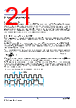
21 / 44 page  P9242-R3/RB Datasheet © 2019 Integrated Device Technology, Inc. 21 May 17, 2019 8. Communication Interface 8.1 Modulation/Communication Wireless medium-power charging systems implementing the P9242-R3 as the transmitter with the WPC-1.2 Extended Power Profile use two- way communication for power transfer: receiver-to-transmitter and transmitter-to receiver. Receiver-to-transmitter communication is accomplished by modulating the load seen by the receiver's coil; the communication is purely digital and logic 1’s and 0’s are carried on the power signal. Modulation is done with amplitude-shift keying (ASK) modulation using with a bit-rate of 2Kbps (for details, see sections 8.3 and 8.4). To the transmitter, this appears as an impedance change, which results in measurable variations of the transmitter’s coil. The power transmitter demodulates this variation of the coil current or voltage to receive the packets. 8.2 Bit Encoding Scheme for FSK Transmitter-to-receiver communication is accomplished by frequency-shift keying (FSK) modulation over the power signal frequency. The power transmitter P9242-R3 can modulate FSK data in the power signal frequency and use it in order to establish the handshaking protocol with the power receiver. The P9242-R3 implements FSK communication when used in conjunction with WPC-compliant receivers, such as the P9221-R3. The FSK communication protocol allows the transmitter to send data to the receiver using the power transfer link in the form of modulating the power transfer signal. This modulation appears in the form of a change in the base operating frequency (fOP) to the modulated operating frequency (fMOD) in periods of 256 consecutive cycles. Communication packets are transmitted from the transmitter to the receiver with less than 1% positive frequency deviation following any receiver-to-transmitter communication packet. The frequency deviation based on any given operating frequency is calculated using Equation 1. fMOD= 60000 60000 fOP −3[KHz] Equation 1 Where fMOD is the change in frequency in the power signal frequency; fOP is the base operating frequency of power transfer; and 60000kHz is the frequency of the internal oscillator that handles counting the period of the power transfer signal. The FSK byte-encoding scheme and packet structure comply with the WPC specification revision 1.2. The FSK communication uses a bi-phase encoding scheme to modulate data bits into the power transfer signal. The start bit will consist of 512 consecutive fMOD cycles (or logic ‘0’). A logic ‘1’ value will be sent by sending 256 consecutive fOP cycles followed by 256 fMOD cycles or vice versa, and a logic ‘0’ is sent by sending 512 consecutive fMOD or fOP cycles. Figure 19. Example of Differential Bi-phase Encoding for FSK tCLK = 256/fOP ONE ZERO ONE ZERO ONE ONE ZERO ZERO 512 cycles 256 cycles |
|
链接网址 |
| ALLDATASHEET是否为您带来帮助? [ DONATE ] |
关于 Alldatasheet | 广告服务 | 联系我们 | 隐私政策 | 数据表链接 | 链接交换 | 制造商名单 All Rights Reserved©Alldatasheet.com |
| Russian : Alldatasheetru.com | Korean : Alldatasheet.co.kr | Spanish : Alldatasheet.es | French : Alldatasheet.fr | Italian : Alldatasheetit.com Portuguese : Alldatasheetpt.com | Polish : Alldatasheet.pl | Vietnamese : Alldatasheet.vn Indian : Alldatasheet.in | Mexican : Alldatasheet.com.mx | British : Alldatasheet.co.uk | New Zealand : Alldatasheet.co.nz |
|
Family Site : ic2ic.com |
icmetro.com |
 Chinese ▼
 English
 Chinese
 German
 Japanese
 Russian
 Korean
 Spanish
 French
 Italian
 Portuguese
 Polish
 Vietnamese
 Indian
 Mexican
 British
 New Zealand