|
数据搜索系统,热门电子元器件搜索 |
|
|
数据搜索系统,热门电子元器件搜索 |
|
CORTEX-R82 数据表(PDF) 5 Page - Arm Limited (or its affiliates). |
|
|
|||||||||||||||||||||||||||||
CORTEX-R82 数据表(HTML) 5 Page - Arm Limited (or its affiliates). |
|
|
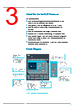
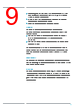
5 / 13 page  5 Instruction Fetch Unit The Instruction Fetch Unit (IFU) fetches instructions from the Instruction Tightly Coupled Memory (ITCM), from the Low Latency RAM (LLRAM) port, or from the Main Master (MM) port. The IFU predicts the outcome of branches in the instruction stream and passes the instructions to the Data Processing Unit (DPU) for processing. Data Processing Unit The DPU decodes and executes instructions. It executes instructions that require data transfer to or from the memory system by interfacing to the Load Store Unit (LSU). The DPU includes the Generic Interrupt Controller (GIC) CPU interface, the Performance Monitoring Unit (PMU) and the Advanced SIMD and floating-point support. GIC CPU interface The GIC CPU interface, when integrated with an external distributor component, is a resource for supporting and managing interrupts in a cluster system. PMU The PMU provides six event counters that can be configured to gather statistics on the operation of each core and the memory system. The information can be used for debug and code profiling. Advanced SIMD and floating-point support Advanced SIMD is a media and signal processing architecture that adds instructions primarily for audio, video, 3D graphics, image, speech processing, and machine learning. The floating-point architecture provides support for half-precision, single-precision, and double-precision floating-point operations. The Advanced SIMD architecture, its associated implementations, and supporting software, are also referred to as Arm Neon™ technology. Memory System The Cortex-R82 processor memory system provides various memories and interfaces each tailored to different requirements. The aim is to use some memories and interfaces for more critical real-time requirements and some for less critical real-time requirements. However, the more real-time critical context is also able to access the less real-time critical interfaces and memories although such an access might not be desirable depending on the system design. |
|
|
链接网址 |
| ALLDATASHEET是否为您带来帮助? [ DONATE ] |
关于 Alldatasheet | 广告服务 | 联系我们 | 隐私政策 | 数据表链接 | 链接交换 | 制造商名单 All Rights Reserved©Alldatasheet.com |
| Russian : Alldatasheetru.com | Korean : Alldatasheet.co.kr | Spanish : Alldatasheet.es | French : Alldatasheet.fr | Italian : Alldatasheetit.com Portuguese : Alldatasheetpt.com | Polish : Alldatasheet.pl | Vietnamese : Alldatasheet.vn Indian : Alldatasheet.in | Mexican : Alldatasheet.com.mx | British : Alldatasheet.co.uk | New Zealand : Alldatasheet.co.nz |
|
Family Site : ic2ic.com |
icmetro.com |
 Chinese ▼
 English
 Chinese
 German
 Japanese
 Russian
 Korean
 Spanish
 French
 Italian
 Portuguese
 Polish
 Vietnamese
 Indian
 Mexican
 British
 New Zealand