 |
数据搜索系统,热门电子元器件搜索 |
|
|
数据搜索系统,热门电子元器件搜索 |
|
The question interval is too short.
Please try again in a few seconds.

Hello, Please ask a question about EPF10K100 Datasheet
# Example questions:
➢ Explain the function of a logic array block (lab) within the flex 10k architecture and how it interacts with the embedded array blocks (eabs).
➢ What are the primary advantages of using the embedded array blocks (eabs) in the flex 10k architecture compared to the ram blocks found in typical fpgas?
➢ Describe the fasttrack interconnect and explain how it contributes to the performance of the flex 10k device.
| Part No. | EPF10K100 |
| Manufacturer | ALTERA |
| Size | 1Mb |
| Pages | 128 pages |
| Description | Embedded Programmable Logic Device Family |

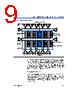
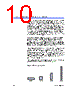


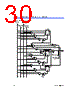


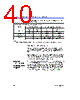
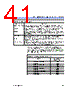


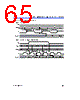


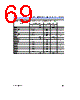


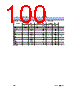


Overall Device: FLEX 10K
️· Type: A field-programmable gate array (FPGA). This means it's a programmable logic device, unlike a fixed-function chip (like a microcontroller). It can be configured to implement almost any digital circuit.
️· Key Goal: High performance, flexibility, and efficient use of resources. This is achieved through a carefully designed architecture.
1. Core Architecture and Interconnect
️· Building Blocks: LABs (Logic Array Blocks) and EABs (Embedded Array Blocks): The device is built from these fundamental units.
️· FastTrack Interconnect: A high-speed routing network that connects the LABs and EABs across the entire device. This is essential for fast signal propagation.
️· Dedicated Inputs: Six dedicated inputs provide efficient distribution of high-speed control signals. Crucial for timing-critical operations.
️· IOEs (I/O Elements): These elements handle the input and output signals to the chip. They provide features like slew-rate control and tri-state buffers.
2. Embedded Array Blocks (EABs)
️· Purpose: Flexible blocks of RAM (Random Access Memory) with registers. Used to implement larger digital functions, such as multipliers, filters, and error correction circuits.
️· Key Features:
- Flexibility in Configuration: Can be configured into various sizes (256x8, 1024x2, 2048x1).
- RAM Cascading: Multiple EABs can be combined into larger memory blocks up to 2048 words without impacting timing.
- Register Options: Registers can be independently inserted on input, output, address and WE inputs.
️· Advantage over FPGAs: Provide predictable timing and simplify routing for larger memory blocks compared to traditional FPGA memory architectures.
3. Logic Array Blocks (LABs)
️· Structure: Each LAB contains eight LEs (Logic Elements), along with carry and cascade chains and control signals.
️· Purpose: Provide the coarse-grained structure of the FPGA, enabling efficient routing and utilization of resources.
️· LEs (Logic Elements): The fundamental logic units within a LAB. They contain look-up tables (LUTs) for implementing logic functions.
️· LAB Local Interconnect: Provides flexibility in routing signals within and between LABs.
4. Key Technologies and Optimizations
️· Look-Up Tables (LUTs): Used within LEs to implement logic functions. LUT-based implementations are faster than traditional gate-based approaches.
️· Parameterized Functions (LPM functions): Allows the software to optimize the use of EABs and LUTs for specific design requirements.
️· Self-Timed RAM: The EAB’s synchronous RAM simplifies timing compared to asynchronous RAM, reducing complexity.
In essence, the FLEX 10K architecture prioritizes speed, flexibility, and efficient resource utilization by:
️· Modular Design: Utilizing LABs and EABs as building blocks.
️· Fast Interconnect: The FastTrack interconnect ensures rapid signal propagation.
️· Optimized Memory Architecture: Using EABs for large memory blocks.
️· Advanced Logic Implementation: LUTs and LPM functions to streamline logic design.
Overall Device: FLEX 10K
️· Type: A field-programmable gate array (FPGA). This means it's a programmable logic device, unlike a fixed-function chip (like a microcontroller). It can be configured to implement almost any digital circuit.
️· Key Goal: High performance, flexibility, and efficient use of resources. This is achieved through a carefully designed architecture.
1. Core Architecture and Interconnect
️· Building Blocks: LABs (Logic Array Blocks) and EABs (Embedded Array Blocks): The device is built from these fundamental units.
️· FastTrack Interconnect: A high-speed routing network that connects the LABs and EABs across the entire device. This is essential for fast signal propagation.
️· Dedicated Inputs: Six dedicated inputs provide efficient distribution of high-speed control signals. Crucial for timing-critical operations.
️· IOEs (I/O Elements): These elements handle the input and output signals to the chip. They provide features like slew-rate control and tri-state buffers.
2. Embedded Array Blocks (EABs)
️· Purpose: Flexible blocks of RAM (Random Access Memory) with registers. Used to implement larger digital functions, such as multipliers, filters, and error correction circuits.
️· Key Features:
- Flexibility in Configuration: Can be configured into various sizes (256x8, 1024x2, 2048x1).
- RAM Cascading: Multiple EABs can be combined into larger memory blocks up to 2048 words without impacting timing.
- Register Options: Registers can be independently inserted on input, output, address and WE inputs.
️· Advantage over FPGAs: Provide predictable timing and simplify routing for larger memory blocks compared to traditional FPGA memory architectures.
3. Logic Array Blocks (LABs)
️· Structure: Each LAB contains eight LEs (Logic Elements), along with carry and cascade chains and control signals.
️· Purpose: Provide the coarse-grained structure of the FPGA, enabling efficient routing and utilization of resources.
️· LEs (Logic Elements): The fundamental logic units within a LAB. They contain look-up tables (LUTs) for implementing logic functions.
️· LAB Local Interconnect: Provides flexibility in routing signals within and between LABs.
4. Key Technologies and Optimizations
️· Look-Up Tables (LUTs): Used within LEs to implement logic functions. LUT-based implementations are faster than traditional gate-based approaches.
️· Parameterized Functions (LPM functions): Allows the software to optimize the use of EABs and LUTs for specific design requirements.
️· Self-Timed RAM: The EAB’s synchronous RAM simplifies timing compared to asynchronous RAM, reducing complexity.
In essence, the FLEX 10K architecture prioritizes speed, flexibility, and efficient resource utilization by:
️· Modular Design: Utilizing LABs and EABs as building blocks.
️· Fast Interconnect: The FastTrack interconnect ensures rapid signal propagation.
️· Optimized Memory Architecture: Using EABs for large memory blocks.
️· Advanced Logic Implementation: LUTs and LPM functions to streamline logic design.
| Part No. | EPF10K100 |
| Manufacturer | ALTERA |
| Size | 1Mb |
| Pages | 128 pages |
| Description | Embedded Programmable Logic Device Family |
| ALLDATASHEET是否为您带来帮助? [ DONATE ] |
关于 Alldatasheet | 广告服务 | 联系我们 | 隐私政策 | 数据表链接 | 链接交换 | 制造商名单 All Rights Reserved©Alldatasheet.com |
| Russian : Alldatasheetru.com | Korean : Alldatasheet.co.kr | Spanish : Alldatasheet.es | French : Alldatasheet.fr | Italian : Alldatasheetit.com Portuguese : Alldatasheetpt.com | Polish : Alldatasheet.pl | Vietnamese : Alldatasheet.vn Indian : Alldatasheet.in | Mexican : Alldatasheet.com.mx | British : Alldatasheet.co.uk | New Zealand : Alldatasheet.co.nz |
|
Family Site : ic2ic.com |
icmetro.com |
 Chinese ▼
  English
 German
 Japanese
 Russian
 Korean
 Spanish
 French
 Italian
 Portuguese
 Polish
 Vietnamese
 Indian
 Mexican
 British
 New Zealand