|
数据搜索系统,热门电子元器件搜索 |
|
|
数据搜索系统,热门电子元器件搜索 |
|
AS3953 数据表(PDF) 12 Page - ams AG |
|
|
|||||||||||||||||||||||||||||
AS3953 数据表(HTML) 12 Page - ams AG |
|
|
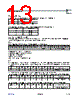
12 / 42 page  www.ams.com Revision 1.0 12 - 42 AS3953 Datasheet - D e t a il e d D es c r i pt io n 7.5 ISO 14443A Level-4 Protocol Mode When Level-4 Protocol mode is selected the PICC Logic autonomously execute complete ISO 14443A Level-3 communication and certain commands of Level-4. This also includes the anti-collision sequence during which the AS3953 UID number is read by the PCD (7 bytes UID is supported), the AS3953 is brought in the selected state (ISO14443-4) in which data exchange between the AS3953 and the PCD can start. On this level also a reading and writing of the AS3953 EEPROM is possible. In case the configuration bit irq_l4 is set an interrupt is automatically sent to controller once the PICC Logic enters in ACTIVE(*) state (after sending SAK on Cascade Level 2). Support of ISO 14443A Level-4. ISO 14443A-4 commands RATS, PPS and DESELECT are implemented in the PICC Logic. RATS and PPS define communication parameters, which are going to be used in the following data exchange by using the block transmission protocol. The advantage of implementing PPS that defines the bit rate used for communication, is that all bit rate issues are handled by the PICC Logic. The MCU gets the information about the actual receive and transmit bit rate by reading a dedicated display register. It has to be fast enough to serve receive and transmit at the maximum bit rate. Execution of the block transmission protocol is left to the controller. In case of receiving the block data from the PCD the PICC Logic provides support by detecting and removing start bit, stop bit, parity bits and CRC. Parity bits and CRC are also checked. When the block data is sent to the PCD the PICC Logic calculates and inserts start bit, parity bits, CRC and stop bit. DESELECT puts the PICC Logic in HALT state. An interrupt is sent to controller upon reception of DESELECT command to inform it that PCD stopped the Level-4 communication. Additionally to supporting the ISO14443-4 transmitting protocol the PICC Logic accepts also proprietary commands. Proprietary commands are identified by setting the two MSB bits of first transmitted byte to ‘01’ (This combination is not used by ISO 14443A Level-4 protocol). The following custom commands are implemented: Wake-up: Sends a wake-up interrupt to controller Read EEPROM: Reads data from EEPROM Write EEPROM: Writes data to EEPROM Support of ISO 14443A Optional Features. CID is supported NAD is not supported Historical bytes are not supported Power level indication is not supported 7.5.1 Coding of UID Anti-collision procedure is based on Unique Identification Number (UID). The AS3953 supports double UID size (7 bytes). First three bytes of UID are hard-wired inputs to the PICC Logic ( uid<23:0>). Last 4 bytes of UID are stored in EEPROM UID word. First Byte of UID (uid0). First byte of UID is according to [ISO3] ISO/IEC 7816-6 IC Manufacturer ID. It is coded on bits uid<7:0>. ams IC Manufacturer ID is 3F(hex). Second Byte of UID (uid1). Second byte of UID – uid<15:8> is reserved for ams chip type (IC Type). Every ams RFID tag IC has its own chip type attributed. Therefore PCD which has read the RFID tag UID knows to which tag IC it is talking. The AS3953 IC type is 10(hex). |
|
链接网址 |
| ALLDATASHEET是否为您带来帮助? [ DONATE ] |
关于 Alldatasheet | 广告服务 | 联系我们 | 隐私政策 | 数据表链接 | 链接交换 | 制造商名单 All Rights Reserved©Alldatasheet.com |
| Russian : Alldatasheetru.com | Korean : Alldatasheet.co.kr | Spanish : Alldatasheet.es | French : Alldatasheet.fr | Italian : Alldatasheetit.com Portuguese : Alldatasheetpt.com | Polish : Alldatasheet.pl | Vietnamese : Alldatasheet.vn Indian : Alldatasheet.in | Mexican : Alldatasheet.com.mx | British : Alldatasheet.co.uk | New Zealand : Alldatasheet.co.nz |
|
Family Site : ic2ic.com |
icmetro.com |
 Chinese ▼
 English
 Chinese
 German
 Japanese
 Russian
 Korean
 Spanish
 French
 Italian
 Portuguese
 Polish
 Vietnamese
 Indian
 Mexican
 British
 New Zealand