|
数据搜索系统,热门电子元器件搜索 |
|
|
数据搜索系统,热门电子元器件搜索 |
|
EM357-RTR 数据表(PDF) 114 Page - Silicon Laboratories |
|
|
|||||||||||||||||||||||||||||
EM357-RTR 数据表(HTML) 114 Page - Silicon Laboratories |
|
|
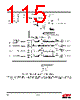
114 / 241 page  Rev 1.3 114 9. General Purpose Timers (TIM1 and TIM2) 9.1. Introduction Each of the EM35x’s two general-purpose timers consists of a 16-bit auto-reload counter driven by a programmable prescaler. They may be used for a variety of purposes, including measuring the pulse lengths of input signals (input capture) or generating output waveforms (output compare and PWM). Pulse lengths and waveform periods can be modulated from a few microseconds to several milliseconds using the timer prescaler. The timers are completely independent, and do not share any resources. They can be synchronized together as described in the "9.3.14. Timer Synchronization" on page 139. The two general-purpose timers, TIM1 and TIM2, have the following features: 16-bit up, down, or up/down auto-reload counter. Programmable prescaler to divide the counter clock by any power of two from 1 through 32768. 4 independent channels for: Input capture Output compare PWM generation (edge- and center-aligned mode) One-pulse mode output Synchronization circuit to control the timer with external signals and to interconnect the timers. Flexible clock source selection: Peripheral clock (PCLK at 6 or 12 MHz) 32.768 kHz external clock (if available) 1 kHz clock GPIO input Interrupt generation on the following events: Update: counter overflow/underflow, counter initialization (software or internal/external trigger) Trigger event (counter start, stop, initialization or count by internal/external trigger) Input capture Output compare Supports incremental (quadrature) encoders and Hall sensors for positioning applications. Trigger input for external clock or cycle-by-cycle current management. Figure 9.1 shows an overview of a timer's internal structure. Note: Because the two timers are identical, the notation TIMx refers to either TIM1 or TIM2. For example, TIMx_PSC refers to both TIM1_PSC and TIM2_PSC. Similarly, “y” refers to any of the four channels of a given timer, so for example, OCy refers to OC1, OC2, OC3, and OC4. |
|
链接网址 |
| ALLDATASHEET是否为您带来帮助? [ DONATE ] |
关于 Alldatasheet | 广告服务 | 联系我们 | 隐私政策 | 数据表链接 | 链接交换 | 制造商名单 All Rights Reserved©Alldatasheet.com |
| Russian : Alldatasheetru.com | Korean : Alldatasheet.co.kr | Spanish : Alldatasheet.es | French : Alldatasheet.fr | Italian : Alldatasheetit.com Portuguese : Alldatasheetpt.com | Polish : Alldatasheet.pl | Vietnamese : Alldatasheet.vn Indian : Alldatasheet.in | Mexican : Alldatasheet.com.mx | British : Alldatasheet.co.uk | New Zealand : Alldatasheet.co.nz |
|
Family Site : ic2ic.com |
icmetro.com |
 Chinese ▼
 English
 Chinese
 German
 Japanese
 Russian
 Korean
 Spanish
 French
 Italian
 Portuguese
 Polish
 Vietnamese
 Indian
 Mexican
 British
 New Zealand