|
数据搜索系统,热门电子元器件搜索 |
|
|
数据搜索系统,热门电子元器件搜索 |
|
EM357-RTR 数据表(PDF) 25 Page - Silicon Laboratories |
|
|
|||||||||||||||||||||||||||||
EM357-RTR 数据表(HTML) 25 Page - Silicon Laboratories |
|
|
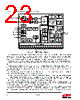
25 / 241 page  Rev 1.3 25 4. Radio Module The radio module consists of an analog front end and digital baseband as shown in Figure 3.1 on page 23. 4.1. Receive (RX) Path The RX path uses a low-IF, super-heterodyne receiver that rejects the image frequency using complex mixing and polyphase filtering. In the analog domain, the input RF signal from the antenna is first amplified and mixed down to a 4 MHz IF frequency. The mixers’ output is filtered, combined, and amplified before being sampled by a 12 MSPS ADC. The digitized signal is then demodulated in the digital baseband. The filtering within the RX path improves the EM35x’s co-existence with other 2.4 GHz transceivers such as Zigbee/ 802.15.4-2003, IEEE 802.11-2007, and Bluetooth radios. The digital baseband also provides gain control of the RX path, both to enable the reception of small and large wanted signals and to tolerate large interferers. 4.1.1. RX Baseband The EM35x RX digital baseband implements a coherent demodulator for optimal performance. The baseband demodulates the O-QPSK signal at the chip level and synchronizes with the IEEE 802.15.4-2003-defined preamble. An automatic gain control (AGC) module adjusts the analog gain continuously every ¼ symbol until the preamble is detected. Once detected, the gain is fixed for the remainder of the packet. The baseband despreads the demodulated data into 4-bit symbols. These symbols are buffered and passed to the hardware-based MAC module for packet assembly and filtering. In addition, the RX baseband provides the calibration and control interface to the analog RX modules, including the LNA, RX baseband filter, and modulation modules. The Ember software includes calibration algorithms that use this interface to reduce the effects of silicon process and temperature variation. 4.1.2. RSSI and CCA The EM35x calculates the RSSI over every 8-symbol period as well as at the end of a received packet. The linear range of RSSI is specified to be at least 40 dB over temperature. At room temperature, the linear range is approximately 60 dB (–90 dBm to –30 dBm input signal). The EM35x RX baseband provides support for the IEEE 802.15.4-2003 RSSI CCA method. Clear channel reports busy medium if RSSI exceeds its threshold. 4.2. Transmit (TX) Path The EM35x TX path produces an O-QPSK-modulated signal using the analog front end and digital baseband. The area- and power-efficient TX architecture uses a two-point modulation scheme to modulate the RF signal generated by the synthesizer. The modulated RF signal is fed to the integrated PA and then out of the EM35x. 4.2.1. TX Baseband The EM35x TX baseband in the digital domain spreads the 4-bit symbol into its IEEE 802.15.4-2003-defined 32- chip sequence. It also provides the interface for the Ember software to calibrate the TX module to reduce silicon process, temperature, and voltage variations. 4.2.2. TX_ACTIVE and nTX_ACTIVE Signals For applications requiring an external PA, two signals are provided called TX_ACTIVE and nTX_ACTIVE. These signals are the inverse of each other. They can be used for external PA power management and RF switching logic. In transmit mode the TX baseband drives TX_ACTIVE high, as described in Table 7.5 on page 57. In receive mode the TX_ACTIVE signal is low. TX_ACTIVE is the alternate function of PC5, and nTX_ACTIVE is the alternate function of PC6. See "7. GPIO (General Purpose Input/Output)" on page 50 for details of the alternate GPIO functions. The digital I/O that provide these signals have a 4 mA output sink and source capability. 4.3. Calibration The Ember software calibrates the radio using dedicated hardware resources. |
|
链接网址 |
| ALLDATASHEET是否为您带来帮助? [ DONATE ] |
关于 Alldatasheet | 广告服务 | 联系我们 | 隐私政策 | 数据表链接 | 链接交换 | 制造商名单 All Rights Reserved©Alldatasheet.com |
| Russian : Alldatasheetru.com | Korean : Alldatasheet.co.kr | Spanish : Alldatasheet.es | French : Alldatasheet.fr | Italian : Alldatasheetit.com Portuguese : Alldatasheetpt.com | Polish : Alldatasheet.pl | Vietnamese : Alldatasheet.vn Indian : Alldatasheet.in | Mexican : Alldatasheet.com.mx | British : Alldatasheet.co.uk | New Zealand : Alldatasheet.co.nz |
|
Family Site : ic2ic.com |
icmetro.com |
 Chinese ▼
 English
 Chinese
 German
 Japanese
 Russian
 Korean
 Spanish
 French
 Italian
 Portuguese
 Polish
 Vietnamese
 Indian
 Mexican
 British
 New Zealand